
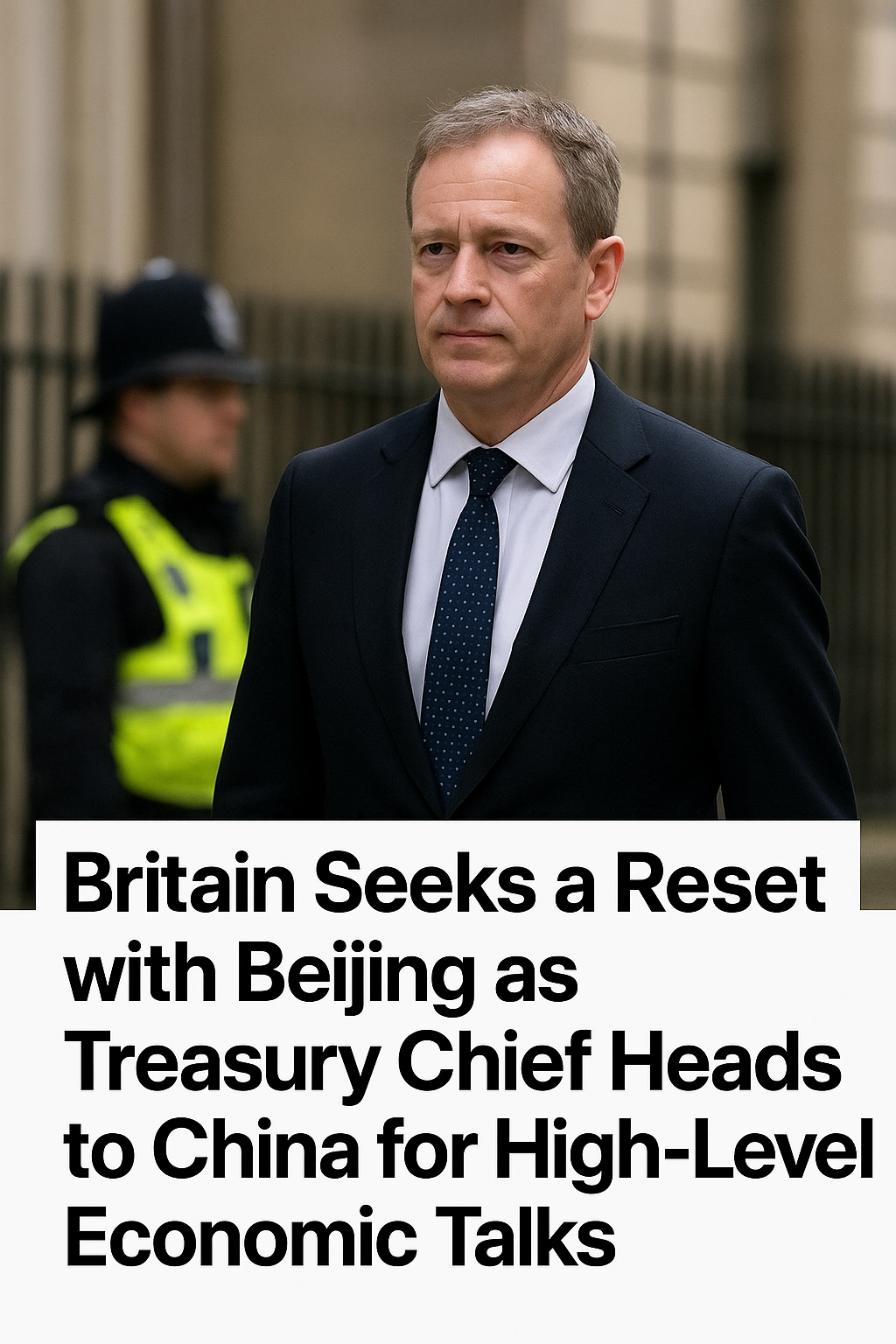

Britain Seeks a Reset with Beijing as Treasury Chief Heads to China for High-Level Economic Talks
Britain’s Chancellor of the Exchequer is preparing to embark on a pivotal diplomatic mission to China this weekend, marking the most significant effort in years to restore structured economic engagement between London and Beijing. The visit signals the Labour government’s intention to rebuild a relationship that has been strained by geopolitical tensions, security concerns, and the long disruption caused by the pandemic.
Chancellor Rachel Reeves will spend several days in Beijing and Shanghai, where she is expected to meet with senior Chinese officials — including Vice Premier He Lifeng — to discuss trade, investment, and broader financial cooperation. The Treasury confirmed that reviving the long-stalled China–U.K. Economic and Financial Dialogue (EFD) will be central to the agenda, reflecting a renewed push for stability and pragmatism in the bilateral relationship.
A Strategic Visit Aimed at Rebuilding Trust
Reeves’ trip comes at a critical moment for the U.K., which is grappling with sluggish economic growth and seeking new avenues for international trade partnerships. Britain has designated China as its fourth-largest single trading partner, but diplomatic friction and global uncertainty have weighed heavily on bilateral cooperation in recent years.
Restoring a Key Platform for Economic Engagement
At the heart of Reeves’ mission is the relaunch of the EFD, a once-annual dialogue that served as a key mechanism for resolving market-access issues, fostering regulatory cooperation, and supporting commercial ties across multiple industries. The forum has been dormant since 2019 due to the COVID-19 pandemic and a steep decline in relations following a series of political disputes.
British officials hope restarting the dialogue will help lower trade barriers that U.K. companies face in China, particularly in financial services, automotive manufacturing, consumer goods, and advanced technologies. The government views the EFD as a crucial tool for strengthening commercial relations while maintaining safeguards around national security.
Balancing Engagement with Firm Political Messages
While economic issues will dominate the visit, Reeves is also expected to address several sensitive geopolitical topics. According to the Treasury, she will urge Beijing to cease material or financial support for Russia’s war effort in Ukraine. Additionally, she will raise long-standing concerns about civil liberties and freedoms in Hong Kong — an issue that remains a point of contention between the two governments.
This dual approach reflects the Labour government’s emerging China strategy: increasing cooperation where possible, but remaining vocal about disagreements on security and human rights.
High-Level Delegation Reflects the Visit’s Importance
Reeves will be joined by a substantial delegation representing Britain’s financial institutions and regulatory bodies, underscoring the trip’s economic focus. Bank of England Governor Andrew Bailey, the chief executives of the Financial Conduct Authority and the London Stock Exchange Group, and senior leaders from major banks including HSBC and Standard Chartered will accompany her.
Showcasing British Business in China
During her stay in Beijing, the chancellor is expected to visit several prominent U.K. companies operating in the Chinese market. These include Jaguar Land Rover, which has an extensive manufacturing and distribution presence in the country; Diageo, known for its strong whisky exports; and Brompton, the iconic folding bicycle manufacturer.
These visits are intended to highlight the contribution of British firms to the Chinese market and to demonstrate the government’s support for businesses seeking to expand their footprint in Asia.
A Broader Diplomatic Effort Under the Starmer Government
Reeves’ trip follows a series of recent high-level engagements aimed at recalibrating the U.K.’s approach to China. Foreign Secretary David Lammy visited Beijing in October, while Prime Minister Keir Starmer met President Xi Jinping on the sidelines of the G20 summit in Brazil in November.
A “Pragmatic” Approach to a Complex Relationship
Starmer, who entered office in July, has outlined a policy framework built on what officials refer to as the “three Cs”: challenge, compete, and cooperate. This means confronting Beijing on issues such as security risks and human rights abuses, competing in areas like advanced technology and global supply chains, and cooperating on shared priorities including climate change, health security, and the transition to clean energy.
The Labour government argues that complete disengagement from China is neither realistic nor beneficial for the U.K.’s long-term interests. Instead, ministers have promoted a nuanced strategy that balances economic opportunity with national security vigilance.
Criticism from the Opposition
Not all political voices in Westminster support the government’s approach. Several figures within the Conservative Party have criticized Starmer for what they view as an overly conciliatory stance. They argue that strengthening economic ties should not overshadow concerns about espionage, cybersecurity threats, and the erosion of democratic freedoms in Hong Kong.
These concerns intensified recently after reports emerged that an alleged Chinese agent had developed close connections with prominent British figures, including Prince Andrew, while carrying out covert political activities on behalf of China’s Communist Party. Intelligence officials have cited the case as evidence of Beijing’s increasingly sophisticated influence operations.
Despite the criticism, Lammy has emphasized that many sectors of U.K.–China trade pose no security risk and that pursuing economic cooperation does not preclude taking firm positions on sensitive issues. Reeves is expected to echo these messages during her visit.
Economic Stakes for the United Kingdom
The U.K.’s renewed focus on China comes as Britain faces persistent economic challenges, including low productivity growth, weak business investment, and uncertainty in global markets. China remains a vital destination for British exports and a significant source of inward investment, although relations have cooled in the past five years.
Opportunities for British Industry
For British manufacturers, financial firms, and consumer brands, China’s vast market offers potential for growth — particularly in sectors where U.K. companies have strong international reputations. Automobiles, spirits, pharmaceuticals, renewable energy technology, and financial services are among the industries with the most to gain from improved market access and regulatory cooperation.
Financial institutions, in particular, are eager to expand services in China’s rapidly evolving capital markets. Senior figures from the City of London hope that the revival of the EFD could lead to more predictable regulatory frameworks and increased collaboration between the two countries’ financial regulators.
Managing Risks and Safeguards
British officials remain clear that economic engagement must be accompanied by robust protections for national security, data privacy, and technological resilience. The government continues to enforce restrictions on sensitive technologies such as advanced semiconductors and telecommunications equipment. Ministers have also stressed the need for diversified supply chains to reduce overdependence on any single market.
This balanced approach aims to position the U.K. as a reliable partner to China without compromising strategic interests or democratic values.
Looking Ahead: A Delicate but Necessary Reset
Rachel Reeves’ visit to China represents a significant milestone in the Labour government’s effort to reshape U.K.–China relations. While the partnership faces ongoing political tensions and competing strategic priorities, both sides stand to benefit from restored dialogue and practical economic cooperation.
The revival of the Economic and Financial Dialogue — if successful — could provide a structured platform for addressing commercial barriers, encouraging bilateral investment, and stabilizing a relationship that has been unsettled for several years. For Britain, the trip reflects a broader recognition that engagement, rather than isolation, is essential in navigating the complex realities of global geopolitics.