
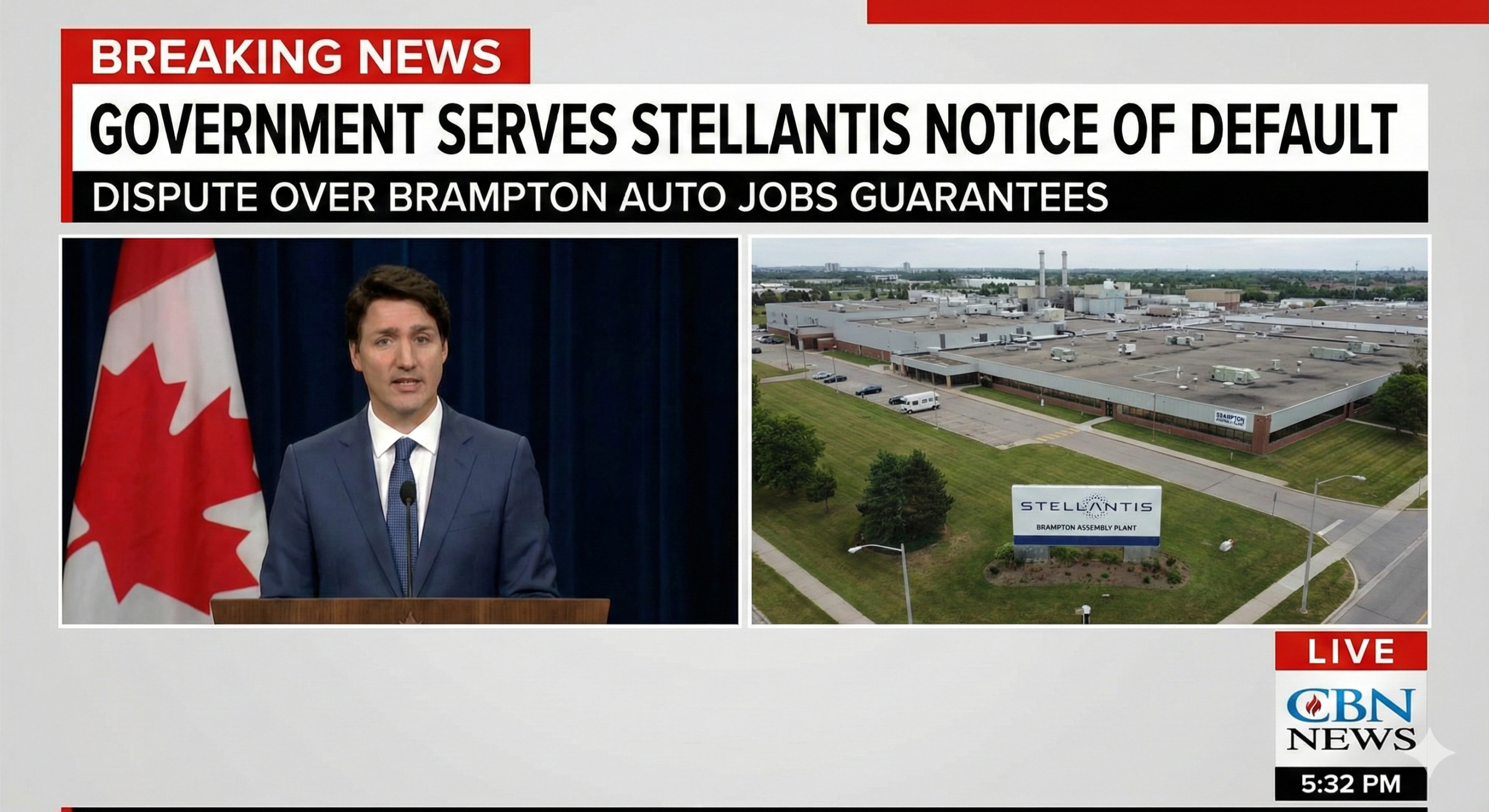

Federal Government Serves Stellantis Notice of Default Over Brampton Auto Jobs
The federal government has formally served automaker Stellantis with a “notice of default” under contracts tied to its operations at the Brampton Assembly Plant, following the company’s plans to move Jeep Compass production to a U.S. facility. The announcement, made by Industry Minister Melanie Joly, signals the government’s commitment to protecting thousands of Canadian auto jobs.
Protecting Auto Jobs at Brampton Assembly
Minister Joly Speaks in Parliament
On December 4, Industry Minister Melanie Joly addressed the House of Commons’ Standing Committee on International Trade, emphasizing the importance of defending domestic auto jobs.
“When it comes to protecting auto jobs, we will not let these industries down. We’ll stand firm for the sake of our workers, our industries and our nation because defending these jobs means defending Canada’s economic backbone and the livelihoods of countless families,” she said.
The notice of default follows a formal dispute-resolution process triggered by Joly on November 3, after the federal government raised concerns over Stellantis’ plan to shift production away from Brampton. At the time, Joly noted that Stellantis had made commitments to invest in the Brampton plant, and the government expected those promises to be honoured fully.
Stellantis Responds
A spokesperson for Stellantis Canada, LouAnn Gosselin, confirmed the company continues to engage with the government as part of the dispute-resolution process.
“We are working toward our shared objective of securing a long-term, sustainable future for automotive manufacturing in Canada, including in Brampton. The process is confidential and so we cannot comment further,” Gosselin said in an email on December 5.
Parliamentary Debate and Contract Questions
Conservative MPs Raise Concerns
During the committee meeting, Conservative MP Adam Chambers questioned Minister Joly about reports that officials had not fully read the Stellantis contracts before they were signed.
Joly clarified that she was not in her current position when the agreements were finalized years ago. She noted there were multiple contracts involved, and while the opposition claimed access, she emphasized that the government’s priority had been to protect jobs at the Brampton plant.
Chambers pressed further about whether the contracts guaranteed 100 per cent of Stellantis’ Canadian footprint. Joly responded that there was a jobs guarantee linked to new funding for plants in Windsor and Brampton, which was crucial for ensuring employment stability.
Historical Context
Joly contrasted the current government’s approach with previous administrations. She said the 2009 Conservative government had negotiated subsidies for GM and Chrysler without a full jobs guarantee, leading to closures of the Oshawa, Windsor, and Ford plants, as well as the Mississauga Orion Bus assembly plant.
“It was devastation, and we were the first government to bring back jobs in the auto sector because we were able to create around 3,000 jobs in Windsor, and we were able to create around 3,000 jobs in St. Thomas,” she said.
The Trigger: Jeep Compass Relocation
October Notice from Stellantis
Minister Joly revealed she became aware of the potential relocation of Jeep Compass production around October 15, after receiving a 24-hour heads-up from Stellantis’ global CEO.
“We thought that was completely unacceptable. We can’t open that floodgate of basically our automakers leaving the country,” Joly said, adding that she immediately sought to ensure Team Canada would work collectively to hold Stellantis accountable.
Stellantis had formally announced the decision to relocate Jeep Compass production to the U.S. on October 14, prompting immediate concern from Canadian auto workers and the federal government.
Union Reaction
The decision triggered a swift response from Unifor’s Stellantis Council, representing over 8,000 workers across Canada. The union held an emergency meeting, issuing a statement calling for the company to reverse its decision and urging a “strong and immediate response” from the government.
Earlier in 2024, the union had already expressed concerns over production delays at the Brampton plant. Unifor Local 1285 president Vito Beato noted that work on the Challenger and Charger gas vehicles stopped at the end of 2023, and retooling for electric vehicle production began in early 2024. However, the process was paused on February 20, initially planned as an eight-week pause, causing anxiety among plant workers.
Economic and Strategic Implications
Auto Sector Employment
The Brampton Assembly Plant is a critical hub for Stellantis Canada, with thousands of jobs at stake. Minister Joly stressed that protecting these positions is not just about a single company but about safeguarding Canada’s broader automotive sector, which employs approximately 125,000 people nationwide.
Federal Support and Industry Investments
The dispute also highlights the government’s approach to linking public support and funding to job creation. Joly emphasized that new funding for the Windsor and Brampton plants was strategically tied to employment guarantees, ensuring taxpayer investments directly supported Canadian jobs.
Risks of Offshoring
The relocation of production to the U.S. underscores a growing concern about offshoring of manufacturing and its impact on Canadian industrial capacity. Joly framed the federal government’s response as a necessary step to prevent further erosion of domestic auto manufacturing.
Next Steps in the Dispute
Notice of Default
Serving Stellantis with a notice of default is part of a formal dispute-resolution process outlined in the company’s agreements with the federal government. The notice signals the government’s position that the automaker may not be meeting its contractual obligations regarding job protection and investment in Canadian operations.
Confidential Negotiations
Both the government and Stellantis are engaged in confidential discussions aimed at resolving the dispute while protecting jobs and maintaining Canada’s automotive manufacturing base. No further public details have been disclosed regarding potential penalties or remedial actions.
Conclusion
The federal government’s action against Stellantis over the planned relocation of Jeep Compass production highlights the ongoing tension between corporate strategy and national industrial policy. By serving a notice of default, Canada is asserting the importance of job protection, investment commitments, and the long-term viability of domestic auto manufacturing.
For workers at the Brampton Assembly Plant and across Stellantis facilities in Canada, the government’s firm stance provides a critical line of support. As negotiations continue, all parties appear committed to finding a solution that safeguards jobs while ensuring a sustainable future for automotive manufacturing in the country.
The coming weeks will be pivotal for the auto sector, with the outcome likely to influence future government-industry relations, investment decisions, and employment security in one of Canada’s most vital manufacturing sectors.