
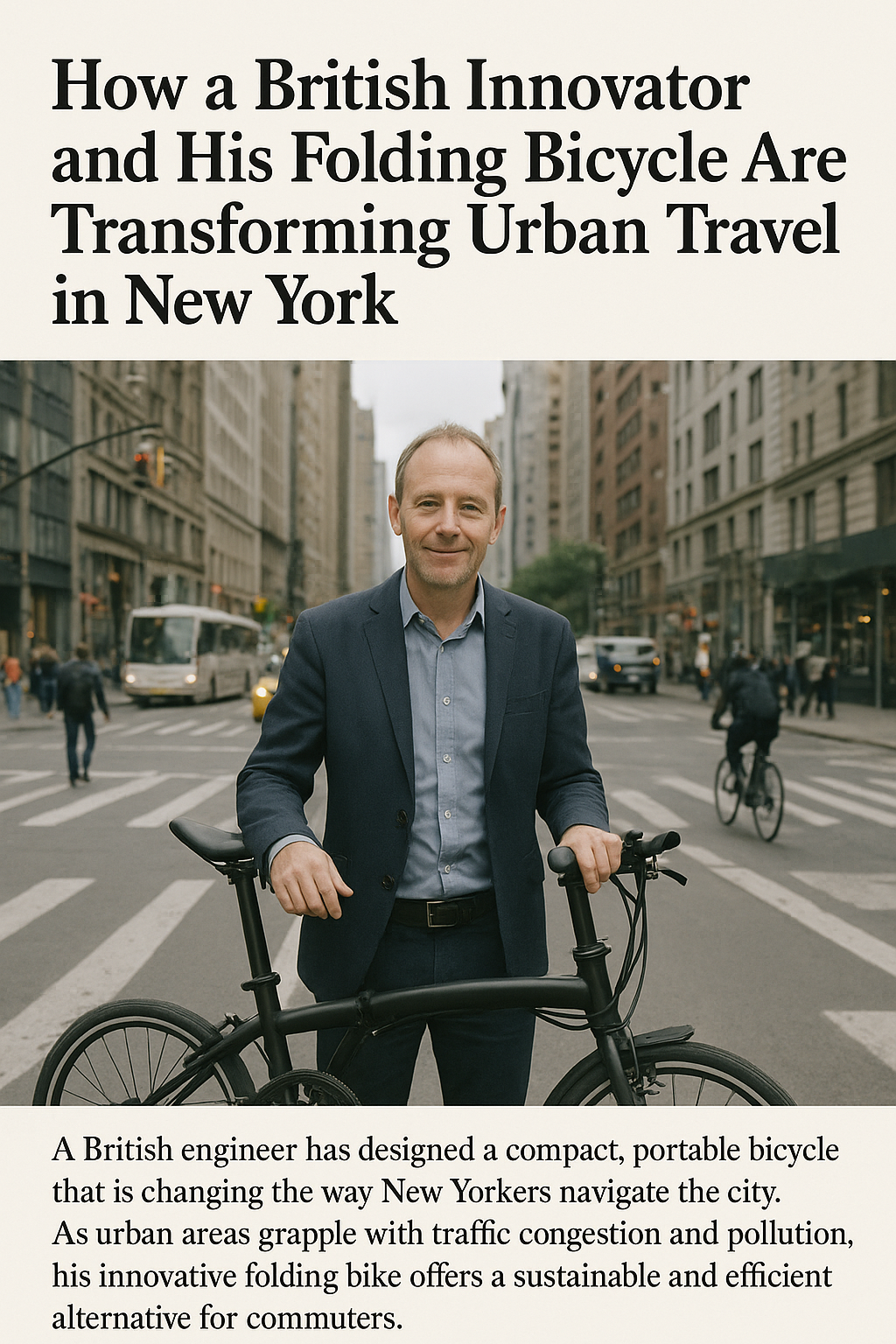

How a British Innovator and His Folding Bicycle Are Transforming Urban Travel in New York
A Vision to Redefine City Mobility Amid a Worsening Climate Crisis
As cities around the world grapple with rising emissions and an urgent need to adopt sustainable transportation, a folding bicycle — and the British engineer behind it — is quietly reshaping how New Yorkers move. Will Butler-Adams, the dynamic head of Brompton Bicycle, believes that compact, easily portable bikes are not merely a convenience but a crucial tool in the global push to cut greenhouse gas emissions. And in a sprawling metropolis like New York, his vision is gaining momentum.
Urban environments produce a significant share of global emissions, with a large portion tied to everyday, short-distance trips. Transportation experts have long emphasized that replacing these “A-to-B” journeys with cleaner alternatives could dramatically reduce pollution. Yet for millions of commuters, rigid schedules, crowded streets, and space constraints present barriers to adopting cycling as a regular mode of travel. Butler-Adams argues that the solution lies in simplicity, convenience, and smart engineering — values embodied in every Brompton bicycle.
The Moment a Bike Disappears: A Simple Trick With Big Implications
A Commuter Demonstration on the East River
One recent scene illustrates just how transformative the concept can be. Aboard the East River Ferry, surrounded by hurried commuters and tourists, Butler-Adams casually demonstrated what he calls a “simple piece of magic.” With a series of quick, origami-like motions, the full-sized bike he had wheeled on moments earlier shrank to roughly one-third of its original size. Within thirty seconds, it was tucked neatly behind a bench, out of everyone’s way.
To the untrained eye, it may have looked like a clever party trick. But for advocates of micromobility — and for urban planners struggling to ease congestion — it symbolized something far more significant: the possibility of seamlessly blending cycling with ferries, trains, buses, and even office spaces, without inconvenience or compromise.
A British Engineering Success Story With Global Ambitions
The Brompton Legacy
Founded in London nearly half a century ago, Brompton has evolved from a small workshop operation into the United Kingdom’s largest bicycle manufacturer. Under Butler-Adams’s leadership, the company has embraced electric technology, widened its international reach, and refined its mission to focus on healthier, cleaner cities.
The folding mechanism that makes a Brompton so distinctive is not a mere novelty. It is the foundation of a design philosophy that prioritizes compactness and efficiency, allowing riders to bring their bikes indoors, store them under desks, or carry them through public transit hubs. This blend of portability and durability has made Brompton especially appealing in dense cities, where space is limited and theft remains a concern.
Engineering Built for Cities, Not Suburbs
“Most bicycles are designed for sport or leisure,” Butler-Adams has often argued. “We build bikes for real life — short trips, quick errands, daily commutes.”
This approach resonates strongly in New York, where many residents rely on public transit but still need flexible first- and last-mile transport options. With subway stations sometimes blocks apart, and with growing concerns about the reliability of taxis and ride-hailing services, the folding bike offers a predictable, affordable alternative.
New York’s Transportation Challenge in a Changing Climate
Short Trips, Huge Impact
While long-distance travel captures much of the climate conversation, the majority of daily city trips measure less than five kilometres. These small journeys add up, contributing heavily to congestion and air pollution.
Replacing even a fraction of car-based short trips with bicycles — especially electric-assist models like Brompton’s — could greatly reduce emissions. For New York, where traffic delays cost billions annually and trigger high levels of stress among commuters, such a shift could be transformative.
A City Ready for Change
In recent years, New York has invested significantly in building protected cycling lanes, converting street space into pedestrian-friendly zones, and expanding ferry routes. These improvements align perfectly with Butler-Adams’s vision.
Yet infrastructure alone cannot drive behavioral change. Many potential cyclists feel intimidated by traffic, unsure about storage options, or reluctant to commit to a traditional bike they cannot easily bring indoors. This is where the folding bike enters as a practical, confidence-boosting alternative.
Inside the Brompton Factory: Where Innovation Meets Craftsmanship
A Marriage of Tradition and Technology
At Brompton’s London factory, where Butler-Adams often showcases the latest electric models, rows of craftspeople hand-braze the steel frames — a time-honored process rarely used in mass-production environments. The combination of artisanal manufacturing and modern design allows Brompton to maintain strict quality control while still innovating.
The electric version of the folding bike, which Butler-Adams demonstrated on the ferry, embodies this blend. Equipped with a compact motor and battery pack, it offers riders an effortless boost on hills and long stretches, making it ideal for commuters who want to arrive at work without sweating through their clothes.
Designed for Portability, Efficiency and Style
Every detail — from the placement of the battery to the weight distribution — is engineered for functionality. Even the color options and sleek silhouette reflect the company’s goal of creating a product that appeals to both practical commuters and design-conscious urban professionals.
Human-Centered Mobility: More Than Just a Bike
Encouraging Healthier, Happier Cities
Butler-Adams frequently stresses that the folding bike revolution is not only about transportation but also about well-being. Cycling encourages daily physical activity, reduces stress, and brings an element of freedom that no subway or bus can replicate.
In a city where many residents spend hours confined to indoor spaces and screen-heavy environments, a compact, go-anywhere bicycle offers a refreshing alternative.
A Tool Against Urban Inequality
Flexible, affordable mobility also supports social equity. Not everyone can buy a car, afford frequent taxi rides, or live near convenient transit stops. A folding bike can bridge those gaps, enabling access to jobs, education, and community resources without financial strain.
Looking Ahead: Can Folding Bikes Help Cities Meet Climate Goals?
A Scalable, Immediate Solution
While large-scale infrastructure projects and policy changes require years of planning, folding bicycles offer an immediate, low-cost intervention. They demand no major urban redesign, operate without emissions, and adapt easily to existing travel patterns.
For climate-conscious cities — and for New Yorkers navigating the challenges of a rapidly warming planet — such ready-to-roll solutions could play an indispensable role in the transition to cleaner transportation.
A Vision Built on Practicality
Butler-Adams’s mission is grounded in the belief that people will choose sustainable options when they are made easy, convenient, and enjoyable. By fitting seamlessly into daily life, the folding bike removes many of the barriers that discourage cycling in traditional forms.
Conclusion: A Small Fold With a Big Future
From a quick demonstration on the East River Ferry to broader efforts across global cities, the Brompton folding bike represents a compelling vision for the future of urban travel. In a world urgently seeking practical climate solutions, its blend of portability, innovation, and human-centered design positions it as more than just a bicycle — it becomes a key part of a cleaner, more connected urban ecosystem.
As New Yorkers embrace new ways to navigate their city, the simple act of folding a bike may prove to be one of the most powerful tools in reshaping everyday mobility and improving the planet’s trajectory.