
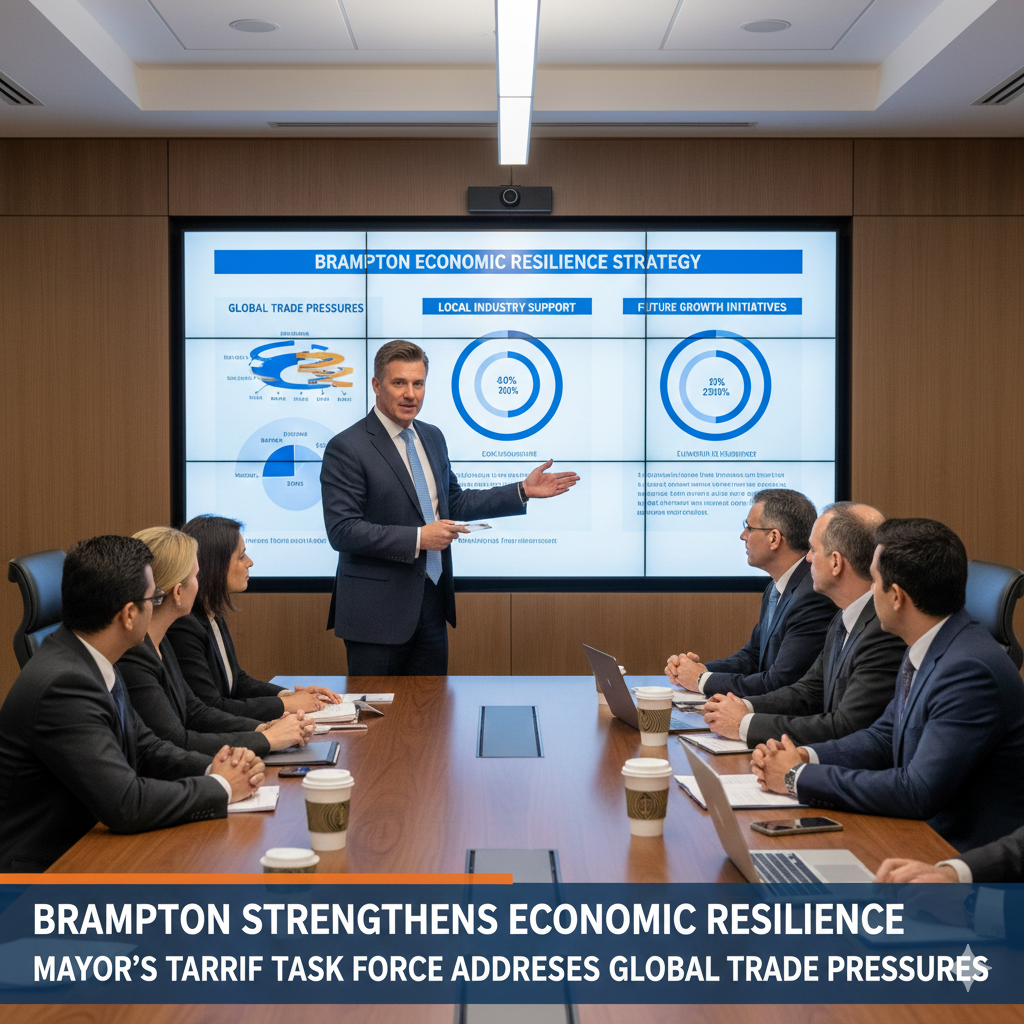

Mayor’s Tariff Task Force Deepens Efforts to Strengthen Brampton’s Economic Resilience Amid Global Trade Pressures
As global trade conditions continue to shift and uncertainty around tariffs persists, the City of Brampton is reinforcing its commitment to protecting and strengthening the local economy. Building on earlier momentum, the Mayor’s Tariff Task Force convened for its second high-level roundtable meeting in late December, bringing together leaders from government, industry, and economic development to chart a path forward for businesses navigating an increasingly complex international trade environment.
Hosted by Invest Brampton, the city’s Economic Development Office, the meeting underscored Brampton’s proactive approach to safeguarding jobs, supporting exporters, and ensuring the city remains competitive on the global stage.
Building on the Foundation Laid Earlier This Year
The second roundtable follows the formal launch of the Mayor’s Tariff Task Force in April, an initiative designed to address the real and potential impacts of tariffs and trade disruptions on Brampton’s diverse economy. From the outset, the task force has focused on collaboration, data-driven policy discussions, and practical solutions for businesses facing rising costs, supply chain disruptions, and shifting market access.
City officials emphasized that the December meeting was not a standalone event, but part of an ongoing strategy to strengthen economic resilience.
By reconvening stakeholders before the end of the year, Brampton aimed to assess progress made since the inaugural meeting, identify emerging risks, and refine support mechanisms for companies operating across borders.
A Cross-Sector Roundtable Reflecting Brampton’s Economic Diversity
Representation From Key Economic Pillars
The roundtable brought together representatives from industries that form the backbone of Brampton’s economy. These sectors play a critical role in employment, innovation, and exports, making them particularly sensitive to changes in global trade policy.
Key sectors represented included:
-
Advanced manufacturing
-
Innovation and technology
-
Food and beverage processing
-
Logistics and supply chain management
This cross-sector participation allowed for a comprehensive discussion of how tariffs and trade barriers affect different parts of the local economy, from raw material sourcing to finished goods distribution.
Industry Leaders Share Frontline Perspectives
Participants included senior leaders and representatives from a wide range of prominent organizations, reflecting both multinational and homegrown enterprises. Among those contributing to the discussion were representatives from MDA Space, Canon Canada, ALMAG Aluminum, Daybar Industries Limited, Peel Plastic Products Ltd., Sofina Foods Canada, Zochem LLC, Adamas International, and Prologis.
Labour and workforce perspectives were also present, with Unifor participating in the discussion, alongside business advocacy and support organizations such as the Brampton Board of Trade and BHive.
Financial and trade support institutions, including TD Commercial Banking, Export Development Canada, and the Trade Commissioner Service, added further depth by highlighting available tools to help businesses manage risk, access new markets, and finance growth.
Together, these voices provided a real-world snapshot of how global trade shifts are being felt on the ground in Brampton.
Federal and Municipal Leadership Align on Trade Strategy
Mayor Patrick Brown Emphasizes Proactive Action
Mayor Patrick Brown played a central role in the meeting, reiterating the city’s determination to stay ahead of global economic challenges rather than reacting after damage has been done.
He emphasized that tariffs and trade disputes are not abstract policy issues but have direct consequences for local employers, workers, and families. By convening the task force, the city aims to ensure Brampton businesses have access to timely information, advocacy, and coordinated support.
The Mayor highlighted that collaboration across levels of government is essential to achieving meaningful results, particularly when dealing with international trade dynamics beyond municipal control.
Federal Presence Reinforces National Commitment
The roundtable was joined by the Honourable Maninder Sidhu, P.C., M.P., Canada’s Minister of International Trade, underscoring the importance of federal-municipal cooperation. His participation provided businesses with direct access to federal insights on trade policy, international negotiations, and export support programs.
Minister Sidhu discussed the federal government’s role in promoting Canadian competitiveness abroad, diversifying trade relationships, and supporting companies facing tariff-related pressures. His presence also allowed local industry leaders to raise concerns and questions directly with a senior decision-maker.
Regional and City Leaders at the Table
Regional Councillor Gurpartap Singh Toor, serving as Chair of Economic Development, and Regional Councillor Rowena Santos, Vice-Chair, also took part in the discussions. Senior members of Brampton’s Economic Development team contributed data, analysis, and updates on city-led initiatives aimed at supporting investment, innovation, and workforce development.
This mix of political leadership and technical expertise helped ensure discussions were both strategic and grounded in operational realities.
Addressing the Real-World Impacts of Tariffs
Supply Chains, Costs, and Competitiveness
One of the central themes of the roundtable was the impact of tariffs on supply chains. Manufacturers and processors shared how increased input costs, delays, and uncertainty can ripple through operations, affecting pricing, contracts, and long-term planning.
Logistics companies highlighted challenges related to border efficiency, transportation costs, and compliance requirements, all of which influence Brampton’s role as a major distribution hub.
Participants stressed that even when tariffs do not apply directly to finished products, indirect effects—such as higher material costs or disrupted supplier relationships—can significantly affect competitiveness.
Supporting Small and Medium-Sized Enterprises
While large multinational firms may have more resources to adapt to trade disruptions, small and medium-sized enterprises often face greater vulnerability. Task force discussions emphasized the need for targeted support for these businesses, including access to market intelligence, financing tools, and export readiness programs.
Representatives from Export Development Canada and the Trade Commissioner Service outlined available supports designed to help companies mitigate risk, identify alternative markets, and navigate regulatory requirements abroad.
Strengthening Brampton’s Economic Resilience
Innovation and Diversification as Long-Term Solutions
Beyond immediate tariff concerns, the roundtable focused on long-term resilience strategies. Diversifying export markets, investing in innovation, and strengthening local supply chains were identified as key priorities.
Technology and innovation leaders highlighted the importance of research and development, automation, and digital transformation in helping companies remain competitive regardless of trade fluctuations.
City officials noted that Brampton’s growing innovation ecosystem, combined with its strategic location and skilled workforce, positions it well to adapt—provided businesses have the right supports in place.
Collaboration as a Competitive Advantage
A recurring message throughout the meeting was that collaboration itself is a critical economic asset. By bringing together government, industry, labour, and financial institutions, the Mayor’s Tariff Task Force creates a platform for shared problem-solving and coordinated advocacy.
Participants agreed that open dialogue helps identify issues earlier and ensures policy responses are informed by real business experiences rather than assumptions.
Next Steps and Ongoing Engagement
From Discussion to Action
City officials confirmed that insights gathered during the second roundtable will inform ongoing work by Invest Brampton and the Mayor’s Tariff Task Force. This includes refining advocacy priorities, enhancing business support programs, and strengthening communication with provincial and federal partners.
Follow-up engagement with participating organizations is expected, ensuring that momentum from the meeting translates into tangible outcomes.
Commitment to Continued Dialogue
The City of Brampton signaled that the task force will continue to meet as trade conditions evolve. Regular engagement allows the city to remain responsive to new challenges while tracking progress on previously identified issues.
By maintaining this ongoing forum, Brampton aims to ensure its economic strategy remains agile and inclusive.
Conclusion: Positioning Brampton for a Changing Global Economy
The second meeting of the Mayor’s Tariff Task Force marked another important step in Brampton’s efforts to protect and strengthen its economy amid global trade uncertainty. By convening leaders from across sectors and levels of government, the city reaffirmed its commitment to collaboration, resilience, and proactive economic leadership.